According to ANSES (the French food safety agency), over 70% of French adults are vitamin D insufficient — a public-health reality that has quietly turned fortified dairy products into a booming market segment. Manufacturers now offer vitamin-D-enriched milks, yogurts, and fromage blancs across every major retail chain in France, positioning fortification as both a nutritional service and a premium price point. But does paying more for a fortified dairy actually deliver vitamin D efficiently — and at what cost compared with a simple supplement? This independent study by NutriCellScience, conducted in May 2026, prices 12 matched pairs of fortified and standard dairy products across five French retailers to answer exactly that question.
Why vitamin D matters
Vitamin D plays a foundational role in calcium absorption, bone mineralisation, immune regulation, and muscle function — and yet it remains one of the most prevalent micronutrient deficiencies in Western Europe. The French food safety agency ANSES set the Population Reference Intake (RNP — Référence Nutritionnelle pour la Population) for adults at 15 µg per day (600 IU) in its 2021 revision, a level that the vast majority of the population struggles to reach through diet and limited sun exposure alone. Natural dietary sources — oily fish, egg yolk, offal — contribute modestly; the EFSA/Sciensano 2022–2023 dietary survey estimates average food intake across comparable European populations at just 5 µg per day, leaving a structural daily shortfall of roughly 10 µg. Fortified foods — dairy products chief among them — and direct supplementation are therefore the two practical levers available to consumers seeking to bridge that gap.
💡 Key takeaways
- 70% of French adults are vitamin D insufficient (ANSES 2021) — the RNP is 15 µg/day (600 IU).
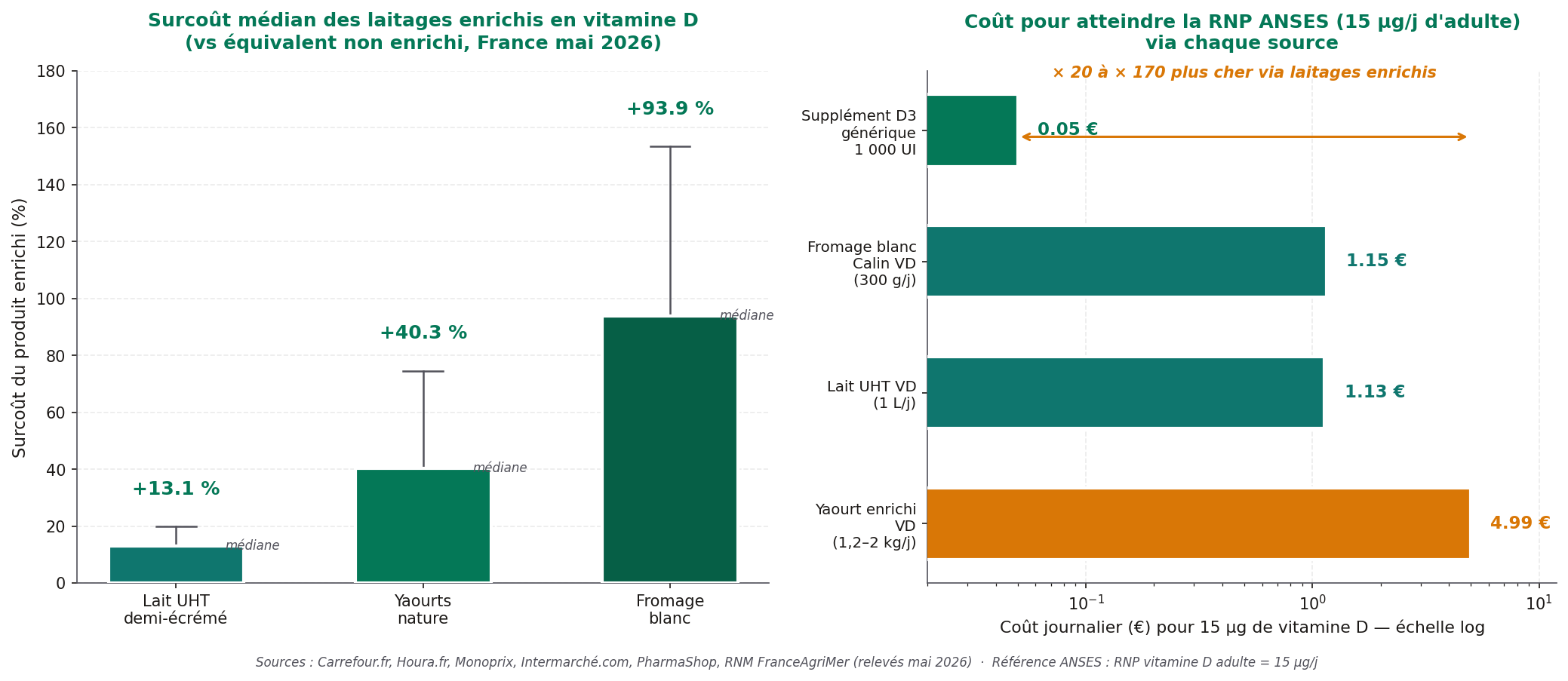
- Fortification costs vary enormously by category: UHT milk carries a near-zero median markup of +13.1%, plain yogurts reach +40.3%, and fortified fromage blanc can command up to +153.5% over an equivalent standard product.
- Calin (Yoplait) holds a quasi-monopoly in fortified fromage blanc, providing 5 µg/100g (100% NRV per 100g) — but at a premium of +94% to +154% versus standard equivalents.
- A generic D3 capsule (1,000 IU / 25 µg) costs ~€0.05/day, making it 20 to 170 times cheaper than obtaining 15 µg through fortified dairy alone.
- Realistic daily volumes to hit 15 µg from dairy only: 1 litre of fortified milk, 1.2–2 kg of fortified yogurt, or 300 g of Calin fromage blanc — volumes well beyond normal consumption patterns.
The study: 12 product pairs across 5 retailers
The study covers three dairy categories — semi-skimmed UHT milk, plain yogurts, and fromage blanc — purchased or price-checked between 13 and 20 May 2026 across five retailers. Prices were collected via online drives and price-comparison services (Carrefour.fr, Houra.fr, PromosCatalogues.fr, Bonial.fr, RNM FranceAgriMer); vitamin D content was verified against official manufacturer product sheets (Lactel, Candia, Yoplait/Calin) and cross-referenced with OpenFoodFacts data via InformationsNutritionnelles.fr. Each fortified product was matched with the closest non-fortified equivalent available in the same or comparable retail environment; unit prices exclude promotions where possible. A standard conversion of 1 µg = 40 IU is applied throughout.
The five retailers reflect the full spectrum of French mass-market grocery: Carrefour and Auchan (national hypermarket/supermarket chains), Leclerc (France’s largest food retail group by volume), Lidl (hard-discount, strong own-label penetration), and Biocoop (France’s leading certified-organic supermarket chain, stocking exclusively organic-certified products under strict cahier des charges rules). As explained in section 9 below, Biocoop’s organic charter effectively excludes vitamin D fortification, making it the natural comparator for unfortified products in the organic tier.
The results: a markup that explodes by category
1. UHT milk: near-zero premium
For everyday semi-skimmed UHT milk, the price premium attached to vitamin D fortification is remarkably thin — and in at least one notable case, completely absent. Lactel’s Vitamine D milk retails at €1.18/litre at Carrefour, while the brand’s premium « Filière » (traceable-supply-chain) standard variant is priced higher at €1.40/litre — meaning fortification is actually cheaper in this pair. Similarly, Candia Viva (multi-vitamin + VD) at €1.20/litre is nearly on par with standard Candia Grandlait at €1.22/litre at Leclerc. This tells a clear market story: vitamin D fortification in UHT milk has become a baseline feature rather than a genuine differentiator, and intense competition has compressed any premium nearly to zero in this category.
For nutrition professionals: across 4 matched pairs, only 2 showed a positive enrichment premium (Lactel VD at Auchan +19.8%; MDD Carrefour vs Lidl Milbona +6.4%). The median markup for the category is +13.1%, with a range of +6.4% to +19.8% on positive pairs. The two negative pairs (Lactel VD vs Filière, −15.7%; Candia Viva vs Candia Grandlait, −1.6%) reflect positioning effects rather than fortification economics. Daily cost to reach 15 µg via fortified UHT milk averages €1.13/day (requiring 1,000 ml/day regardless of brand), confirming that even the cheapest fortified milk route is economically unfavourable relative to supplementation.
2. Plain yogurts: the health-beauty premium (+40%)
Plain yogurts tell a very different story. Here, vitamin D fortification is bundled into a broader « better-for-you » product narrative — and priced accordingly. Activia Bifidus (Danone), which carries a vitamin D claim on product listings, positions itself within the bifidus gut-health franchise; Danone Light & Free (1.25 µg/100g of vitamin D confirmed) occupies the « light » and « skin health » premium segment. Both products carry a meaningful price premium over standard plain yogurts from the same or comparable brands, driven not solely by the cost of the vitamin D additive but by the brand equity and health-positioning layered on top of fortification.
For nutrition professionals: all 4 yogurt pairs show a positive premium. Median markup is +40.3%; the mean reaches +43.0%. The maximum is +74.6%, recorded for Danone Light & Free at €3.65/kg versus Carrefour Classic 0% at €2.09/kg. The minimum is +16.8% (Activia Bifidus standard vs Activia Nature). Vitamin D content in Activia Bifidus classic (full-fat) is estimated at 0.75 µg/100g by analogy with Actimel (confirmed 0.75 µg/100g on Carrefour.fr), as the exact figure is not published in French nutritional tables online; Light & Free’s 1.25 µg/100g is confirmed on both Carrefour.fr and Monoprix. To reach 15 µg/day solely from yogurt, a consumer would need to consume 1,200–2,000 g/day — entirely unrealistic as a dietary strategy.
3. Fromage blanc: Calin’s quasi-monopoly (+94%)
The fortified fromage blanc segment presents the most striking pricing dynamic of the entire study. Calin, the Yoplait (General Mills) brand, is essentially the only mainstream product enriching fromage blanc with vitamin D in French supermarkets — and it does so at a remarkably high level: 5 µg per 100g, equivalent to 100% of the adult daily NRV (Nutrient Reference Value) per 100g portion, as confirmed by product pages on Houra.fr, Intermarché, Monoprix, and Yoplait.fr. Without a direct competitor in the same segment, Calin commands a substantial premium over equivalent unflavoured fromage blancs from own-label ranges.
For nutrition professionals: excluding the Biocoop organic pair (where the non-fortified organic product is more expensive due to the organic/small-pack premium, yielding an inverted −56.0% differential), the three relevant pairs show markups of +93.9% (Calin 0% 850g at Monoprix, €3.47/kg vs Délisse MDD at €1.79/kg), +62.5% (Calin 0% 8×100g at Intermarché, €3.64/kg vs Délisse MDD at €2.24/kg), and +153.5% (Calin 3.2% 450g on Houra, €4.69/kg vs Carrefour Classic 0% at €1.85/kg). The median is +93.9% and the mean across 3 comparable pairs is +103.3%. The high vitamin D density (5 µg/100g) means only 300g/day is needed to reach 15 µg — making fromage blanc the most volume-efficient fortified dairy source — but even at the best price (Calin 0% Monoprix, €1.04/day), the cost remains roughly 20× higher than a generic D3 capsule.
Summary table
| Category | Median markup | Max markup | Volume needed for 15 µg/day | Cost/day for 15 µg |
|---|---|---|---|---|
| UHT semi-skimmed milk | +13.1% | +19.8% | 1,000 ml | €1.00–€1.20/day |
| Plain yogurts | +40.3% | +74.6% | 1,200–2,000 g | €4.31–€5.70/day |
| Fromage blanc (Calin) | +93.9% | +153.5% | 300 g | €1.04–€1.41/day |
| All categories combined | +40.3% | +153.5% | — | €1.00–€5.70/day |
Sources: Carrefour.fr, Houra.fr, Monoprix, Intermarché, PromosCatalogues.fr, RNM FranceAgriMer. May 2026. Markups exclude pairs where the non-fortified product is priced higher for non-fortification reasons (organic premium, premium supply-chain branding). Cost/day calculated as (15 µg ÷ VD content µg/100g or ml) × unit price per kg or litre ÷ 10.
The economic verdict: supplementation remains unbeatable
The cost comparison between fortified dairy and direct vitamin D supplementation is stark. A generic D3 capsule at 1,000 IU (25 µg) — widely available in French pharmacies and parapharmacies — can be found at approximately €0.05 per capsule (e.g. 45 capsules for €3.99 at PharmaShopDiscount). To cover 15 µg per day, a consumer needs roughly 0.6 of such a capsule daily, bringing the effective daily cost to around €0.033–0.053 per day. Across the fortified dairy products studied, the daily cost to reach that same 15 µg threshold ranges from €1.00/day (cheapest fortified milk) to €5.70/day (Activia Bifidus VD at the standard serving volume required), representing a cost ratio of ×20 to ×170 relative to generic supplementation. Even the most cost-efficient fortified dairy option — Calin fromage blanc at around €1.04/day (Monoprix, 850g at €3.47/kg) — remains approximately 20 times more expensive per µg of vitamin D delivered than a generic capsule.
| Source of vitamin D | Daily quantity needed | Cost/day for 15 µg |
|---|---|---|
| Generic D3 supplement 1,000 IU (25 µg/capsule) | 0.6 capsule | ~€0.033–0.053 |
| D3 1,000 IU PharmaShop (45 caps at €3.99) | 0.6 capsule | €0.053 |
| Lactel VD semi-skimmed milk (€1.18/L) | 1,000 ml | €1.18 |
| Candia Viva multi-vitamin milk (€1.20/L) | 1,000 ml | €1.20 |
| MDD VD milk (Carrefour own-label, €1.00/L) | 1,000 ml | €1.00 |
| Activia Bifidus VD yogurt (€2.85/kg) | 2,000 g | €5.70 |
| Danone Light & Free VD yogurt (€3.65/kg) | 1,200 g | €4.38 |
| Calin fromage blanc VD (€3.47/kg, Monoprix) | 300 g | €1.04 |
⚠️ Three traps to avoid
- Paying +94% or more for fortified fromage blanc when a generic D3 capsule costs around €0.05/day — a price ratio of ×20 at best, ×170 at worst. The fortification premium in dairy is nutritionally unjustifiable as a vitamin D delivery mechanism when direct supplementation exists.
- Believing that fortified dairy alone can cover the ANSES RNP of 15 µg/day. The volumes required are unrealistic for any normal diet: 1 full litre of fortified milk, 1.2–2 kg of fortified yogurt, or 300g of Calin fromage blanc every single day. In practice, fortified dairy is a useful marginal contributor, not a sufficient standalone source.
- Assuming organic = fortified — or that the absence of fortification in organic dairy is a nutritional flaw. The EU organic certification framework effectively excludes vitamin D fortification as an artificial additive; neither Biocoop milk nor any organic-certified dairy in this study contains added vitamin D. This is a regulatory constraint, not a quality judgment either way.
The NutriCellScience perspective
Vitamin D fortification in dairy is a legitimate public-health instrument — passive, low-effort, and capable of incrementally improving average population intakes without requiring any behaviour change from the consumer. For the majority of people who are neither aware of their vitamin D status nor motivated to supplement, a fortified milk or yogurt provides a modest but real contribution. The problem is not the fortification itself; it is the nutritional marketing built around it, which can lead consumers to believe they are actively managing their vitamin D needs when, in quantitative terms, they are barely scratching the surface of the ANSES RNP of 15 µg/day. The data from this study make the arithmetic transparent: the volumes of fortified dairy needed to reach 15 µg alone are clinically and practically unrealistic for any adult eating a normal diet. For individuals who have been identified — by a physician or through a blood test — as vitamin D insufficient, direct supplementation with a D3 supplement remains the most evidence-based, dose-controlled, and cost-efficient intervention, at a fraction of the price of any fortified dairy approach. That said, dairy products retain their full nutritional relevance in a balanced diet: they are primary sources of calcium and high-quality protein, and their contribution to broader nutritional strategy should not be discounted simply because their vitamin D payload is limited. Fortification adds value in a layered dietary approach — but it cannot replace targeted supplementation for those with clinical needs.
FAQ
Should I really supplement vitamin D?
For most adults in France and Northern Europe, yes — especially from October to April when sunlight is insufficient for endogenous synthesis. ANSES data show that over 70% of French adults present with vitamin D insufficiency, and dietary intake alone averages only 5 µg/day against a population reference of 15 µg/day. Always discuss with your physician — a simple 25(OH)D blood test determines your actual status before any supplementation decision.
Are fortified dairy products useful for anyone?
Yes — particularly for people who consume significant quantities of dairy daily (children, elderly adults, individuals with high dairy intake for bone-health reasons) and who are not taking a separate supplement. Fortified dairy offers a genuine incremental benefit without requiring any active effort. It becomes nutritionally and economically questionable only when a premium price is paid with the expectation that the product alone covers vitamin D needs.
Why don’t organic dairy products contain added vitamin D?
EU organic certification rules (and the stricter cahier des charges of retailers such as Biocoop) prohibit the use of synthetic additives not naturally present in the food, including fortifying vitamins. Vitamin D fortification in dairy involves adding a synthetic or extracted vitamin D2 or D3 preparation — which falls outside the permitted-additives list for organic products. This is a regulatory classification, not a statement about the nutritional quality of organic dairy.
How much does a month of D3 supplementation cost?
Generic vitamin D3 at 1,000 IU (25 µg) per capsule is available in France from approximately €3.99 for 45 capsules — roughly €0.09/capsule or about €2.70/month for a daily dose. At 1,000 IU per day, a 30-day supply often costs between €2 and €5 depending on brand and format. This makes supplementation one of the most cost-effective nutritional interventions available, with a monthly cost comparable to a single standard yogurt multipack.
Should I choose D2 or D3?
The current scientific consensus, reflected in guidance from EFSA and major clinical nutrition bodies, strongly favours vitamin D3 (cholecalciferol) over D2 (ergocalciferol) for supplementation. D3 raises and maintains serum 25(OH)D levels more effectively than an equivalent dose of D2, and it is the form produced naturally in human skin by UVB exposure. Most generic and branded supplements in European pharmacies now default to D3; check the label and prefer D3 formulations where available.
Sources and references
- Retailers — price data
- Carrefour.fr — Lactel Vitamine D semi-skimmed 1L
- Carrefour.fr — Candia Viva multi-vitamin 1L
- Carrefour.fr — Activia Bifidus Nature 8×125g
- Carrefour.fr — Danone Light & Free VD 1.25 µg/100g
- Carrefour.fr — Fromage blanc 0% Carrefour Classic 1kg
- Houra.fr — Calin fromage blanc 3.2% 450g (€4.69/kg)
- Houra.fr — Activia Bifidus 0% 8×125g (€3.59/kg)
- Monoprix — Calin Extra fromage blanc 0% 850g (€3.47/kg)
- Monoprix — Danone Light & Free 8×125g (€3.65/kg)
- Intermarché — Calin fromage blanc 0% 8×100g (VD 5 µg/100g)
- PromosCatalogues.fr — Candia Leclerc (€1.22/L)
- PromosCatalogues.fr — Fromage blanc Leclerc Délisse (€1.79/kg)
- RNM FranceAgriMer — weekly average UHT milk prices
- Bonial.fr — Lidl semi-skimmed milk Milbona (€0.94/L, Feb 2026)
- Biocoop.fr — Fromage blanc 4% MG organic 400g
- Manufacturers — nutritional data
- Institutional — ANSES / EFSA / CERIN
- ANSES (2021) — Actualisation des références nutritionnelles françaises vitamines et minéraux (RNP vitamine D = 15 µg/j adulte)
- CERIN.org — ANSES vitamin D references: RNP 15 µg/day, 70% of French adults insufficient (2021)
- Sciensano.be — National dietary survey 2022–2023: mean dietary vitamin D intake ~5 µg/day (EFSA)
- Pharmacy / supplementation pricing
🇫🇷 Lire cet article en français : Vitamine D dans les laitages : combien coûte vraiment l’enrichissement ?
— NutriCellScience, Mark DOWN — EN edition

 Nutricellscience
Laisser un commentaire