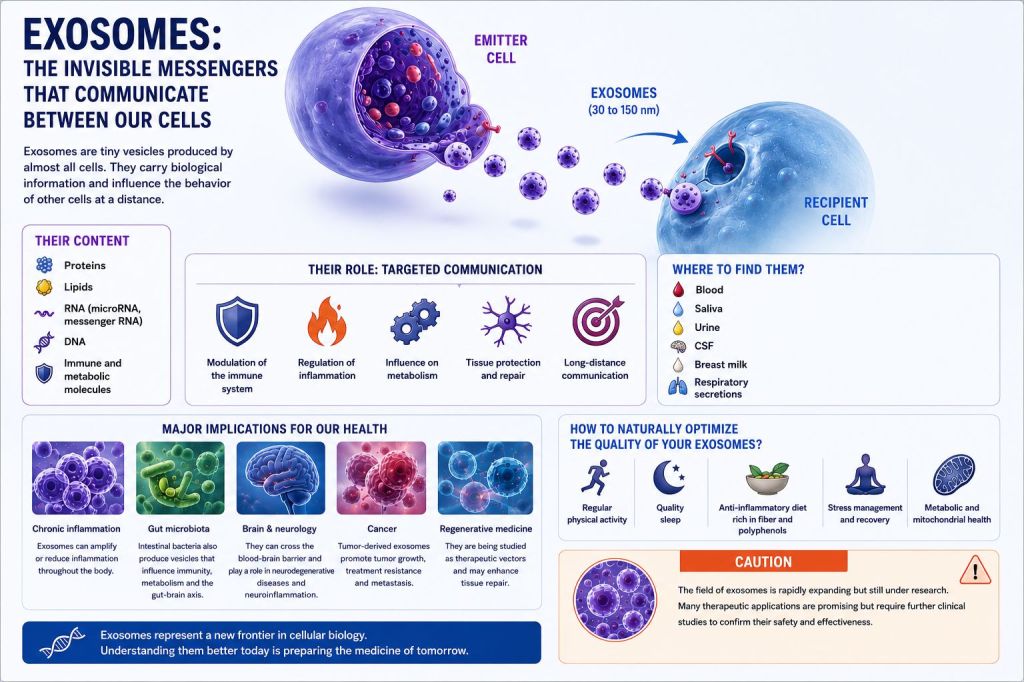
What if your cells were talking to each other — constantly, precisely, across long distances? Underneath every tissue, millions of nano-sized biological capsules, 30 to 150 nanometers wide, are quietly carrying messages between cells. They are called exosomes. And they may be one of the most sophisticated communication systems in biology — a language medicine is only starting to decode.
What exactly is an exosome?
For decades, human biology was framed as a chain of local reactions: a cell produces a molecule, the molecule acts nearby, then disappears. That model is now incomplete. Cells exchange small extracellular vesicles — the most studied of which are exosomes — to carry information across the body, sometimes very far from where they were produced.
These nano-scale structures (30–150 nm) are released by nearly every cell type: neurons, immune cells, intestinal epithelium, muscle fibers, adipocytes, tumor cells — and even the bacteria of the gut microbiome. Inside, they package proteins, lipids, enzymes, microRNAs, messenger RNAs, and occasionally DNA. Each of these molecules can change the behavior of a distant target cell — a true molecular language of the body.
💡 Key takeaways
- Exosomes are nano-vesicles (30–150 nm) released by virtually every cell — including gut bacteria.
- They carry proteins, microRNAs, lipids, and mRNAs, acting as a long-range molecular signaling system.
- They are deeply involved in chronic inflammation, immunity, microbiome dialogue, brain aging, and tissue regeneration.
- Therapeutic exosomes are advancing fast — but most consumer « anti-aging » applications remain marketing ahead of evidence.
Why exosomes are reshaping biomedical research
Unlike hormones, which diffuse broadly, exosomes appear to deliver targeted messages, sometimes to highly specific recipient cells. They can dampen or amplify inflammation, modulate immunity, reshape energy metabolism, support tissue repair — or, conversely, accelerate disease. A « stressed » cell can therefore reach far-away cells without any direct contact.
1. Exosomes and inflammaging
Chronic low-grade inflammation — inflammaging — is now seen as a core driver of biological aging. Certain immune cells release exosomes containing cytokines, pro-inflammatory signals, and inflammatory microRNAs that can amplify oxidative stress, mitochondrial dysfunction, insulin resistance, and atherosclerosis. A 2025 review in Journal of Ovarian Research described how menopause reshapes the circulating exosomal profile and contributes to estrogen-loss-related systemic inflammation (Yang et al., 2025).
2. The fascinating gut microbiome connection
The gut microbiome doesn’t speak only through short-chain fatty acids (butyrate, propionate, acetate). Gut bacteria also release bacterial extracellular vesicles (BEVs), structurally similar to human exosomes. These BEVs can cross the intestinal barrier, engage the immune system, reach the liver, brain, and even the heart. A 2024 review in Gut Microbes mapped their role at the microbiome–immunity interface (Díaz-Garrido et al., 2024), and a 2025 paper in Acta Pharmaceutica Sinica B detailed their growing potential as microbiome-derived drug carriers (2025).
3. Exosomes, mitochondria, and longevity
Mitochondria don’t just produce ATP — they shape the production and cargo of exosomes. This creates a feedback loop: mitochondrial dysfunction fuels inflammation, inflammation reshapes the exosomal profile, and exosomes in turn reprogram cellular metabolism. This is probably one reason regular exercise, deep sleep, moderate caloric restriction, polyphenols, and a diverse microbiome appear to improve exosomal signatures — leverage points reviewed in a recent BBA Mol Basis Dis synthesis of the aging interactome (2025).
4. Exercise and exerkines: an underrated mechanism
Exercise triggers a substantial release of muscle-derived exosomes — known as exerkines. These vesicles carry irisin (FNDC5/irisin), a myokine acting on osteoblasts, brown adipose tissue, and the brain. A study in Aging Cell showed that FNDC5/irisin-enriched exosomes promote osteoblast proliferation and inhibit ferroptosis through caveolin-1 (2024). A meaningful share of exercise’s systemic benefits — insulin sensitivity, anti-inflammatory effects, neuroprotection, mitochondrial adaptation — may therefore be mediated by exosomal signals.
5. The brain link: exosomes and neurodegeneration
Exosomes can cross the blood–brain barrier. That alone is a game-changer. They can shuttle inflammatory signals, microRNAs, and proteins implicated in neurodegenerative diseases. A 2025 review in ACS Applied Bio Materials summarized the therapeutic potential of exosomes for Alzheimer’s, Parkinson’s, and neuroinflammation (2025), while a 2025 paper in Frontiers in Molecular Neuroscience proposed plasma exosomal autophagy-related microRNAs as non-invasive biomarkers of brain aging (2025).
Exosomes as medicines: where do we stand in 2026?
Researchers are actively developing exosomes as therapeutic vehicles: carriers for mRNA, siRNA, targeted small molecules, and anticancer agents. A comprehensive 2025 review in Pharmaceutics mapped exosomes as a next-generation drug delivery platform for cancer, infection, neurological and immunological diseases, gene therapy, and regenerative medicine (2025). A parallel 2025 paper benchmarked the clinical translation of exosome therapy and its emerging indications (2025).
Their main asset: native biocompatibility. Unlike many synthetic nanoparticles, exosomes are already « recognized » by the body — less immunogenic, better tolerated long term, and capable of homing to specific tissues.
Where is the evidence — and where is the hype?
| Domain | Evidence maturity | Target applications |
|---|---|---|
| Biomarkers (cancer, neurodegeneration) | 🟢 Established | Non-invasive diagnostics, monitoring |
| Drug carriers (mRNA, anticancer) | 🟡 Early-stage trials | Cancer, genetic diseases |
| Regenerative medicine (skin, cartilage, bone) | 🟡 Clinical studies underway | Wound healing, aesthetics |
| Neurology (Alzheimer’s, Parkinson’s) | 🔠 Preclinical + early trials | Targeted intracerebral therapy |
| Consumer aesthetic medicine | 🔴 Marketing ahead of science | Injectable « anti-aging » treatments |
⚠️ Weak signals — caution on commercial promises
- Unknown long-term safety: exosomes can carry oncogenic microRNAs depending on their cell of origin. The multi-year tumorigenic risk is not yet settled.
- No standardization: « exosome concentrates » vary enormously by source (stem cells, platelets, plant-derived nanovesicles…) and isolation method.
- Imprecise biodistribution: we still cannot reliably control where injected exosomes go, or how long they remain active.
- Aesthetic marketing outpacing science: aesthetic injections, cosmetic serums, « cellular regeneration »… most consumer products are not backed by randomized clinical trials.
- Regulatory gray zone: their status as biologic, drug, or cosmetic varies by country, with limited oversight.
Can you naturally optimize your exosomes?
No validated method exists to specifically « boost » exosome production. However, everything that improves mitochondrial health and immune balance appears to favorably reshape exosomal profiles. The most biologically coherent levers:
- Regular exercise — endurance, HIIT, resistance training: documented release of muscle exerkines (FNDC5/irisin).
- Quality sleep — sleep deprivation significantly disrupts inflammatory signaling and circulating exosomal profiles.
- Diverse microbiome — fibers, legumes, resistant starches, polyphenols: promotes beneficial bacterial extracellular vesicle production.
- Lower chronic inflammation — manage visceral adiposity, chronic stress, sedentary behavior, ultra-processed foods.
- Metabolic health — exosomes are highly sensitive to glucose, insulin, lipid profile, and oxidative stress.
The NutriCellScience perspective
Exosomes likely represent one of the most consequential biological discoveries of recent decades: a new cellular language, promising biomarkers, and a rapidly maturing therapeutic landscape. But we are still very early on the learning curve.
Our stance: measured scientific enthusiasm, unapologetic commercial skepticism. Yes — extracellular vesicle biology will likely reshape oncology, neurology, and regenerative medicine over the next 10–15 years. No — the « anti-aging » exosome injections sold today in aesthetic clinics do not rest on robust randomized trials, and we recommend against allocating budget to them while long-term data remain absent.
In the meantime, the best way to « invest » in your exosomes is paradoxically the most classical one: move, sleep, feed your microbiome, dampen chronic inflammation. Cellular health doesn’t depend only on the cells themselves — it depends on the quality of the messages they send each other.
FAQ
Are exosomes dangerous?
Endogenous exosomes are continuously produced by your body. Therapeutic exosome products (injections, drug carriers) remain in evaluation: long-term safety and tumorigenic risk are not yet definitively answered.
Are exosomes linked to aging?
Yes. Their profile shifts with age and chronic inflammation. They both reflect and amplify inflammaging.
Can you naturally boost your exosomes?
Exercise, quality sleep, metabolic health, and a diverse microbiome favorably influence exosomal communication.
How are exosomes connected to the microbiome?
Gut bacteria release extracellular vesicles (BEVs) that can cross the intestinal barrier and modulate immunity, metabolism, and even brain function.
Are exosomes already used in clinical medicine?
As diagnostic biomarkers (oncology, neurology), yes. As active therapy, they remain in early-stage clinical trials — not standard practice outside research protocols.
Primary references
- Sahibzada M.U.K. et al. Exosome-Based Drug Delivery: A Next-Generation Platform for Cancer, Infection, Neurological and Immunological Diseases, Gene Therapy and Regenerative Medicine. Pharmaceutics. 2025;17(10):1336. mdpi.com · DOI: 10.3390/pharmaceutics17101336
- Pak T. et al. Clinical Translation and New Indications for Exosome Therapy. 2025. journals.lww.com · DOI: 10.4103/wkrj.wkrj_5_26
- Díaz-Garrido N. et al. Bacterial extracellular vesicles at the interface of gut microbiota and immunity. Gut Microbes. 2024;16(1):2396494. tandfonline.com
- Bacterial extracellular vesicles for gut microbiome–host communication and drug development. Acta Pharm Sin B. 2025. sciencedirect.com
- Exerkine FNDC5/irisin-enriched exosomes promote proliferation and inhibit ferroptosis of osteoblasts through interaction with Caveolin-1. Aging Cell. 2024. onlinelibrary.wiley.com · DOI: 10.1111/acel.14181
- Unveiling Exosome Potential: Transforming Treatments for Neurodegeneration. ACS Appl Bio Mater. 2025. pubs.acs.org · DOI: 10.1021/acsabm.5c00096
- Non-invasive biomarkers for brain aging: the role of autophagy-related microRNAs in plasma exosomes. Front Mol Neurosci. 2025;18:1588007. frontiersin.org
- Yang K. et al. Menopause mysteries: the exosome-inflammation connection. J Ovarian Res. 2025. ovarianresearch.biomedcentral.com · DOI: 10.1186/s13048-025-01591-9
- The aging interactome: From cellular dysregulation to therapeutic frontiers in age-related diseases. BBA Mol Basis Dis. 2025. sciencedirect.com
Originally published in French on May 11, 2026. Read the French version here.
NutriCellScience, Mark DOWN — EN edition

 Nutricellscience
Laisser un commentaire